Understanding lending dashboards: APR, fills and credited interest
A dashboard can show market rates, active-loan APR and credited interest together. They answer different questions; the largest number is not automatically the account’s return.
Read each metric
| Metric | Meaning | Common mistake |
|---|---|---|
| Market APR | Current market reference | Assuming every offer gets it |
| Offer rate | Requested execution terms | Counting interest before a fill |
| Active-loan APR | Annualized rate of outstanding loans | Applying it to idle capital or a whole year |
| Interest ledger | Recorded or credited income | Ignoring currency, fees and dates |
| Available balance | Currently usable amount | Confusing it with total assets |
A weighted-rate example
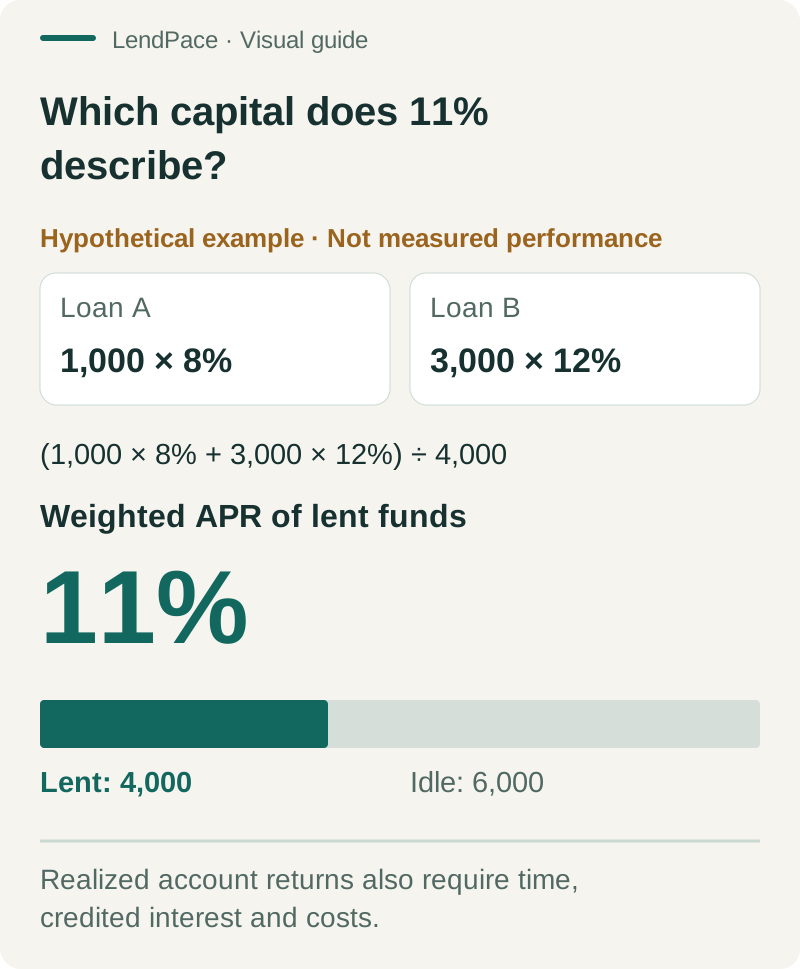
Two same-currency loans of 1,000 at 8% and 3,000 at 12% have an amount-weighted active APR of (1,000 × 8% + 3,000 × 12%) / 4,000 = 11%, not 10%.
If another 6,000 is idle, 11% does not describe all 10,000 principal. Realized return needs time, interest and fees too.
Reconcile consistently
Use identical exchange, currency, period and timezone. Check freshness before interpreting missing records as zero. Deposits and currency appreciation are not lending interest.
The homepage’s public fills are limited observations from a demonstration account, not average customer performance or your own ledger. No active loans does not mean there was never historical income.
Check your records, then apply the net-return method. A single peak fill is not a long-term expectation.
Related reading
- LendPace Basic, Pro and VIP: prices, limits and subscription costs
- LendPace’s 14-day trial: timing, activation and expiry checks
Sources and verification date
Bitfinex Margin Lending · Bitfinex Fees
2026-11-03.
This is operational and educational information. Illustrations are not promised returns. Exchange, liquidity and asset-price risks remain.

