Calculate USDT lending net returns: APR, utilization and fees
Displayed APR is not take-home return. Establish whether rates and interest are gross or net, then include actual capital utilization and subscription costs.
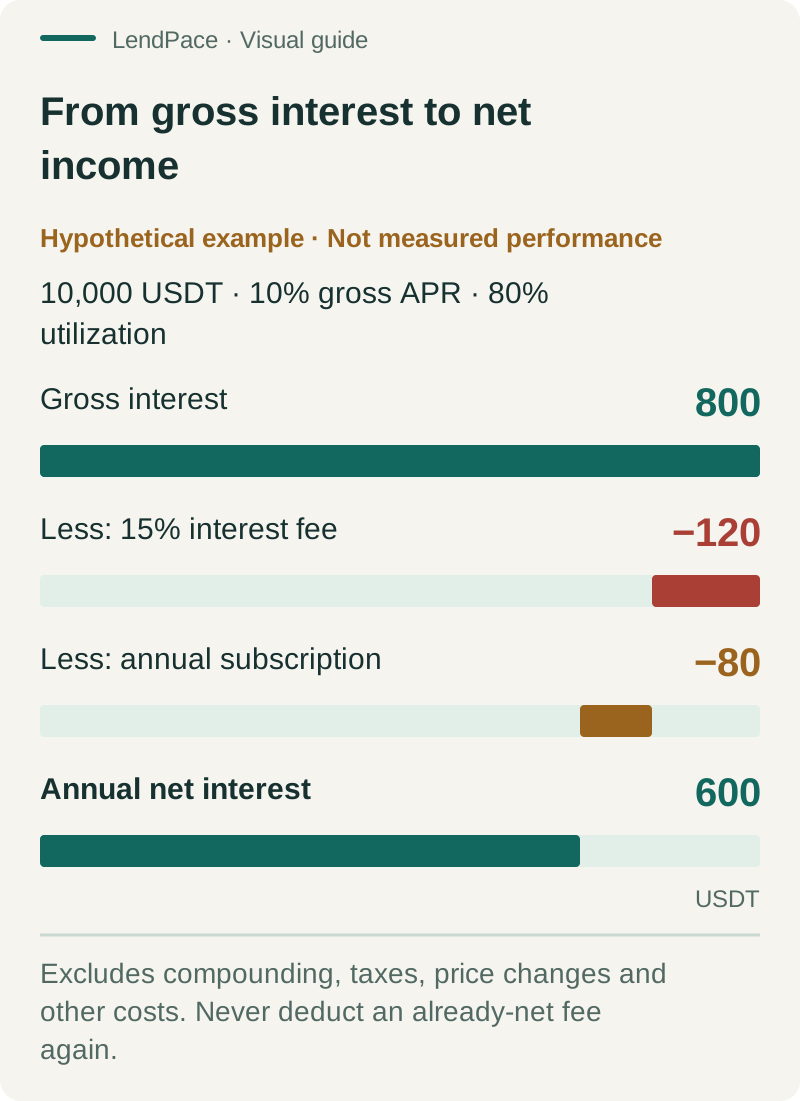
Five inputs
| Symbol | Meaning | Example |
|---|---|---|
| P | Principal | 10,000 USDT |
| r | Gross simple annual rate | 0.10 |
| u | Amount-and-time-weighted utilization | 0.80 |
| f | Interest fee | 0.15 |
| S | Annual subscription | 80 USDT |
Simplified annual net interest: P × r × u × (1 − f) − S.
Here gross interest is 800, exchange fees 120 and subscription 80, leaving 600 USDT, or 6% of principal. This is an assumption, not a forecast; it excludes compounding, tax, exchange rates, transfers and principal losses.
Small balances feel fixed costs more
With the same assumptions:
| Principal | Interest after exchange fees | After annual subscription |
|---|---|---|
| 1,000 | 68 | −12 |
| 5,000 | 340 | 260 |
| 10,000 | 680 | 600 |
Lower rates or utilization reduce these amounts. A negative number here means modeled interest does not cover listed costs, not that the model has calculated market losses.
Measure incremental value
Suppose free native features achieve 70% utilization and a paid tool 80%, with identical 10% gross APR and 15% fees. The extra interest per 10,000 principal is only 85 USDT; after an 80 subscription, the modeled improvement is 5 USDT. These are illustrative inputs, not measured performance.
Do not deduct exchange fees again from already-net ledger interest. For shorter periods allocate costs consistently; deposits and withdrawals require time-weighted capital instead of the ending balance alone.
Related reading
- High Yield or Quick Fill: choose by liquidity and waiting time
- Bitfinex Auto-Renew, FRR and lending bots: what each does
Sources and verification date
2026-11-03.
This is operational and educational information. Illustrations are not promised returns. Exchange, liquidity and asset-price risks remain.

