BTC, ETH and SOL lending versus staking: understanding token returns
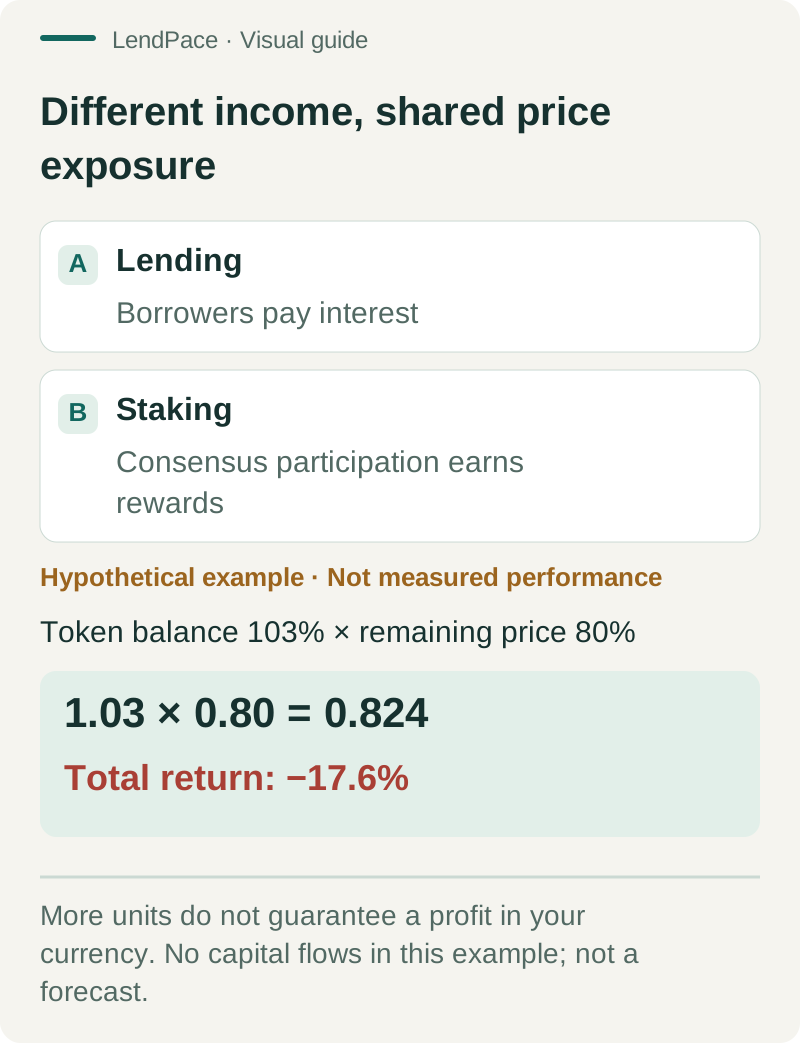
Lending interest comes from borrowers; staking rewards come from consensus participation. Earning more tokens does not guarantee a positive dollar return.
Asset and mechanism matter
ETH and SOL have distinct proof-of-stake arrangements, penalties and exit rules. Do not apply one chain’s rules to another. Bitcoin’s native consensus is not proof of stake; a product called BTC staking requires separate investigation of its protocol, wrappers or custody.
LendPace’s BTC, ETH and SOL features are exchange lending, not native staking or validator operation.
Compare the exposures
| Factor | Exchange lending | Staking |
|---|---|---|
| Income | Borrower interest | Validation and related protocol rewards |
| Main constraints | Demand and loan terms | Protocol, validator or service exit rules |
| Risks | Exchange, borrower, API and liquidity | Protocol, validator, penalties and intermediaries |
| Price exposure | Affects home-currency result | Also affects home-currency result |
Pooled or custodial staking may lower barriers while introducing contracts or intermediaries. Solo, liquid and exchange staking are not identical products.
A price-decline example
Start with one token, receive 0.03 in net interest, make no deposits or withdrawals and assume a 20% price decline. The ending value ratio is 1.03 × 0.80 = 0.824, a −17.6% return. This is an illustration, not a price forecast.
Decide first whether you want the asset exposure, then compare costs, exits and realized income. More units are not a guarantee of principal safety.
Related reading
- Managing multiple lending currencies: assets, exchanges and limits
- Comparing USD, USDT and XAUt lending on a consistent basis
Sources and verification date
Ethereum Staking · Bitfinex Margin Lending
2026-11-03.
This is operational and educational information. Illustrations are not promised returns. Exchange, liquidity and asset-price risks remain.